 |
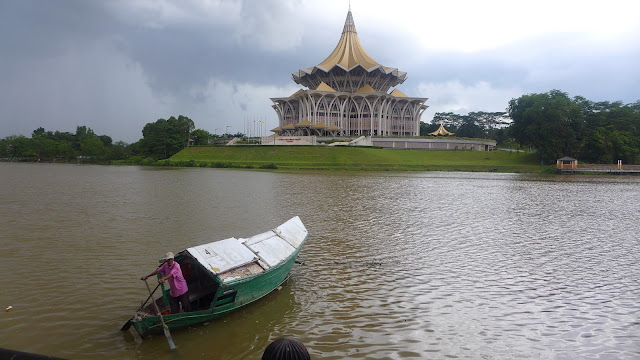
| Sarawak is a semi-autonomous state within the federation of Malaysia, and this spirit of independence is displayed by the uniquely beautiful legislative building for the state which is located across the river from downtown Kuching. It dominates the area, but in a refined way. It really speaks to the independence of the people of Sarawak and the fact that they are members of Malaysia by choice. In the foreground is the only means for crossing the river if you happen to be in downtown, old Kuching. The nearest bridges are a couple of kilometres away up- and downstream. A trip in one of these boats costs about $0.50 to cross. |
Ever since beginning to plan our trip to South East Asia, the island of Borneo has held a special fascination for us. Bowen informs us that technically, Borneo is the third largest island in the world after Greenland and Baffin Island. Orang-utans, headhunters, pygmy elephants and rhinos and tropical jungle made Borneo seem like it would be the most exotic place we would visit. And so far, we have been right!
But not at first. We landed in Kuching, the capital of Sarawak, which is the Malaysian state at the west end of the island. It was spared destruction during World War II, so the old town is still a collection of Chinese shophouses and narrow streets much like we had become used to in Melaka and Penang. It was much more developed than we had been expecting (we pictured longhouses in the jungle alongside a river) but that was not a bad thing. Kuching made a comfortable base for exploring the jungles of Sarawak, and we took advantage of it to make a day trip to Semenggoh, an orang-utan rehabilitation centre, and an multi-day trip to Bako, a national park along the north cost of Sarawak.
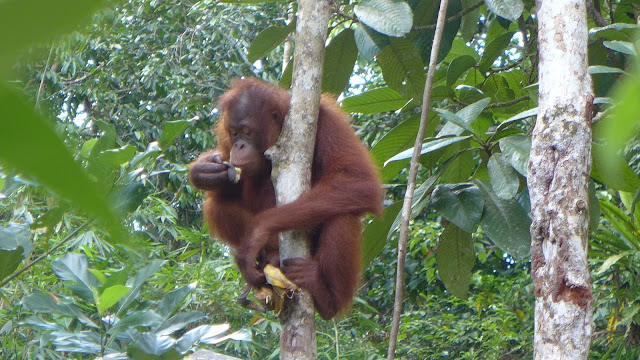 |
| It is amazing how adept these creatures are with all four limbs and how comfortable they are above ground! |
 |
| One of the four orang-utans we got up close and personal with at Semenggoh. The orang-utans here have been rehabilitated from captivity or from being orphaned and all live freely in the jungle. They know, however, that food is provided at the centre twice a day, so they often return to where they know it is safe and the grub is good. If there is a lot of fruit in the jungle, which there apparently was around this time, they will often stay away, but we got lucky on our visit. |
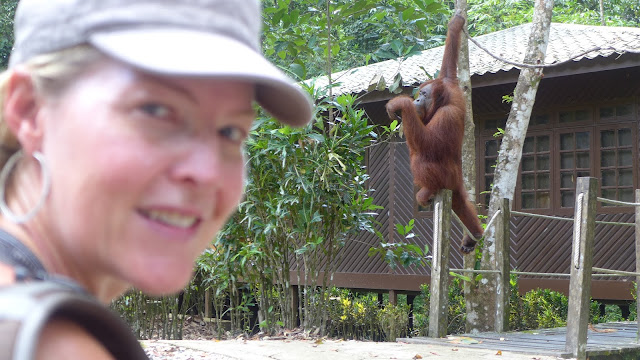 |
| Two mommas in the same photo. They each had young boys are off playing somewhere else out of frame. |
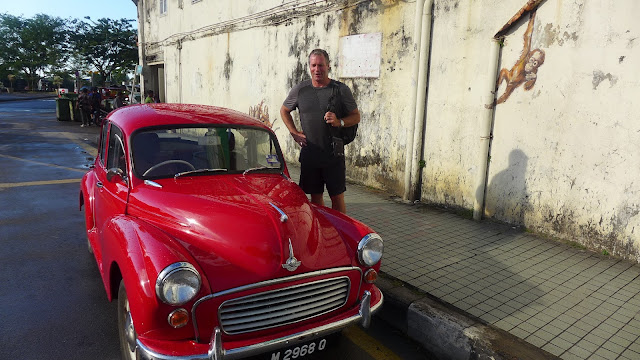 |
| Red Rover, Red Rover, we call Remy over. That is more of Ernest Zacharevic's work on the wall behind (the artist that did the Murals in Georgetown). |
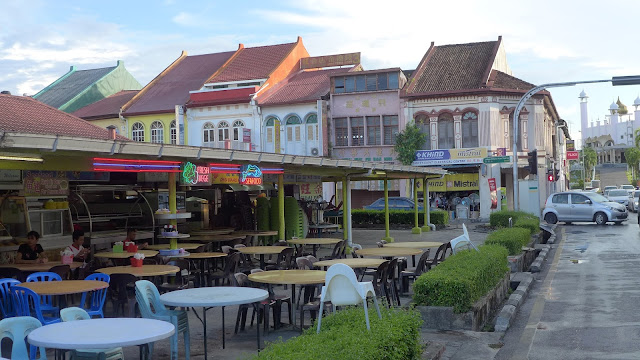 |
| The shophouses here are colourful and well-kept, and food is plentiful and cheap. Now, if only something could be done about the open sewers. |
 |
| Some warehouses near the shipyard on the river started by the Brooke family, the "White Rajas" that ruled Sarawak for nearly a century. The light along the river at sunset was fantastic. |
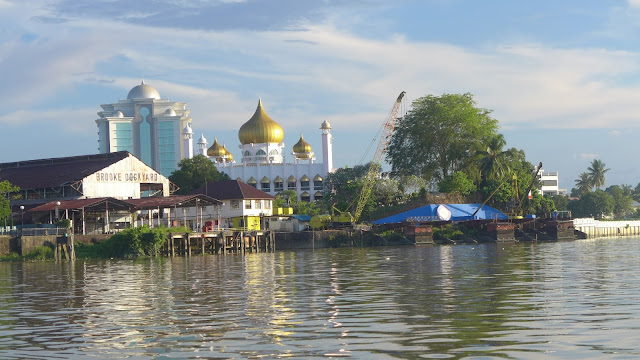 |
| Like the rest of Malaysia, there is a mix of cultures. In the middle ground is a Sikh temple with the golden dome, while in the background is the modern State mosque, the tall glass tower with a dome, dwarfing the minarets on the right side. |
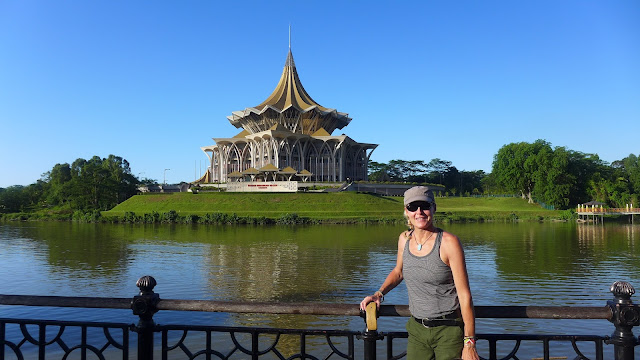 |
| No matter where you go in town, it appears that the parliament building is looking at you. |
 |
| The fishing fleet that docks in Kuching. |
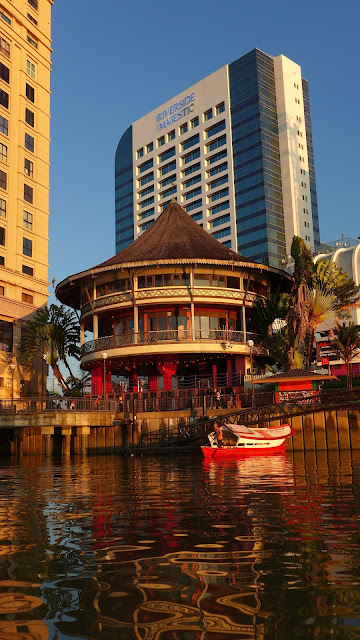 |
| One of the things that makes Kuching so fascinating is the mingling of traditional styles and modernity, which they seem to do better than most. This is a restaurant right above a river taxi dock. |
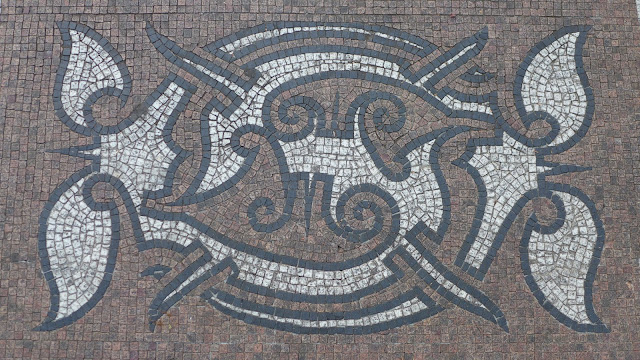 |
| A typical Iban art pattern built into the sidewalk as a mosaic. The Iban art is very distinctive and organic to the jungle where they live (and used to behead their neighbours). |
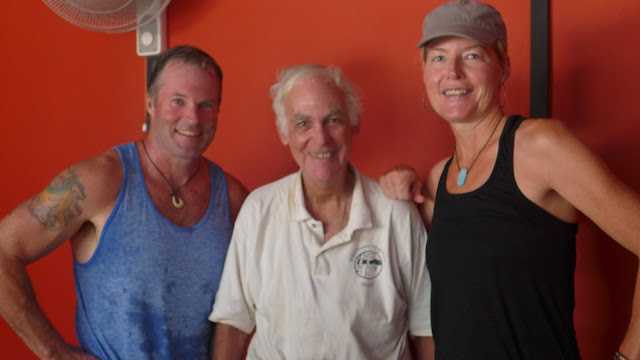 |
| Dick, from New Jersey, shared our guest house and traveled with us for a couple of days. He is in his seventies and suffers the effects of having polio when he was a youngster, but prefers to stay in hostels when he travels in order to meet people and keep himself feeling young. It seems to work! Yes, that is sweat on Remy's shirt! It's HOT. |
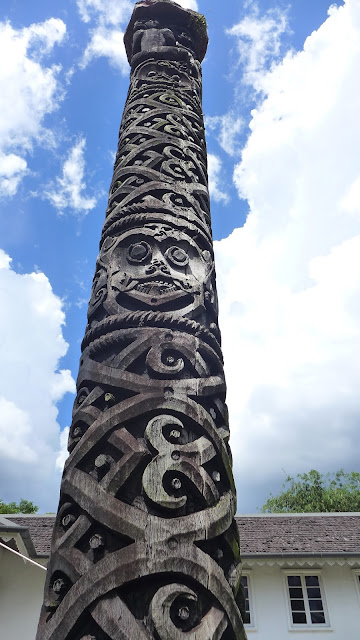 |
| This is an Iban mortuary pole, in which the body of someone wealthy would have been buried. The nature of the carving suggests there is a link between these people, the Polynesians and the coastal native tribes of Western North America. |
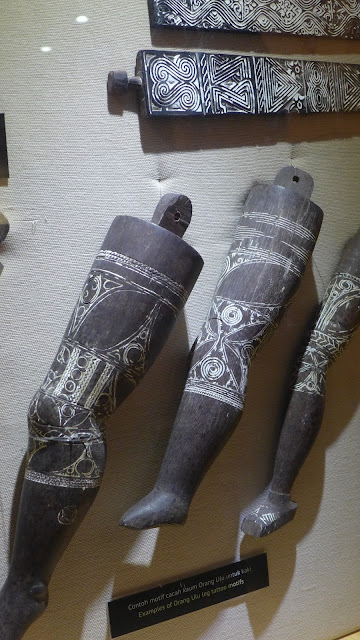 |
| Not all the Iban were headhunters- some were leg men! Just kidding. These are reproductions of the tattooing that Iban women would get to celebrate their achievements, particularly in the field of weaving. This inspired Liz to consider getting another tattoo herself, but it would have interfered with snorkeling as it healed, plus the artist we consulted has worked extensively in North America and Europe and consequently charges those prices now. |
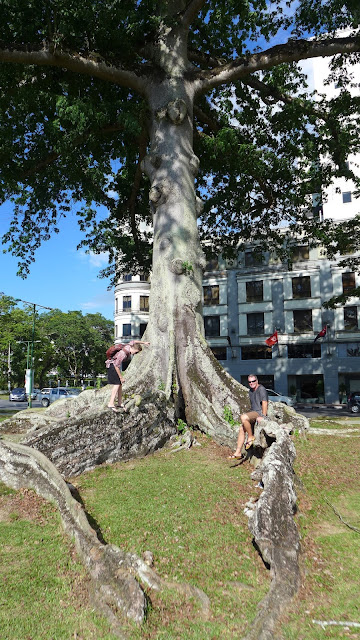 |
| In the Independence Square, or Plaza Merdeka, this giant kapok tree was probably around long before independence was declared. The roots provide some shelter from the mid-day sun, not something you can say about most trees. The entire trunk was covered with thorns. |
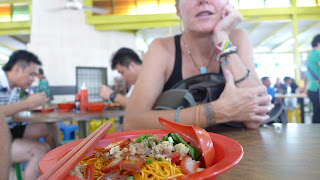 |
| One of our go-to dishes, mee (egg) noodles with ground pork and sliced BBQ pork. Delicious and very cheap! We found our favourite version in a covered hawker centre located right beside the bus station. Remy had his favourite cendol there as well. |
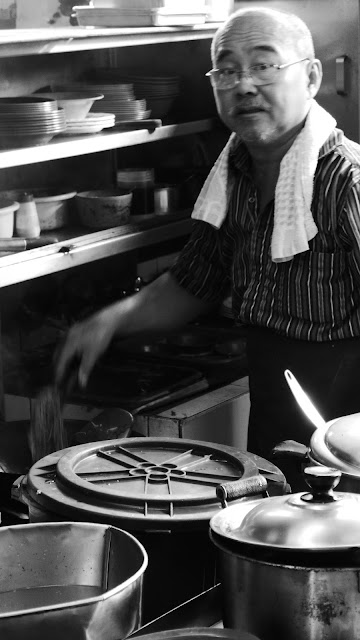 |
| This was our chef. His son told us that his father has been cooking the same dish for over forty years! We can attest that he has got it right. |
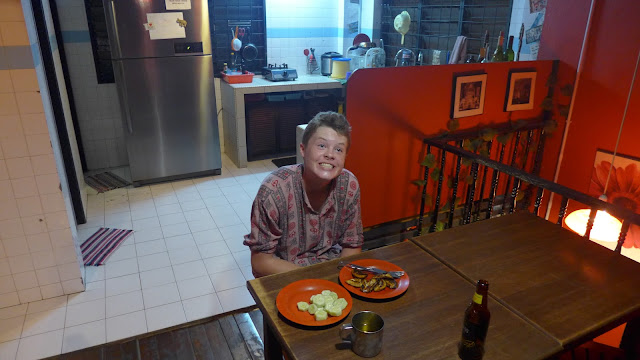 |
| Bowen is becoming a bit of a gourmand himself. He took advantage of the kitchen at the guesthouse to treat us to his specialty, chicken tenders cooked in root beer. It was delicious! |
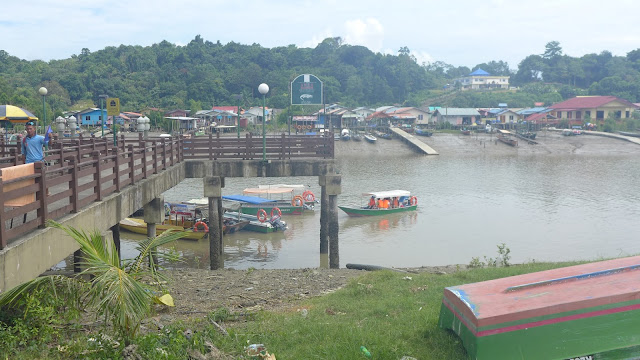 |
| The beginning of our adventure in Bako National Park. The bus drops you off outside the river ferry dock, from where it is about a twenty minute ride to the sea and an unceremonious drop-off on the beach about a kilometer from the park headquarters. The hour-long bus ride from Kuching costs just over a dollar, while the boat ride cost over six! Capitalism in action. |
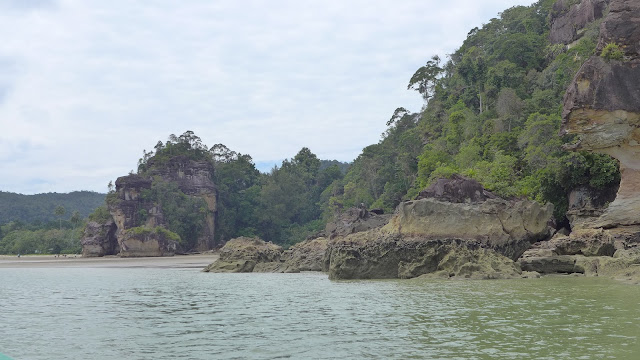 |
| The approach to where we were let off at the park. The jungle grows on the rocks right down to the water. The beach at the left is where we had to hop out of the boat with our bags and wade in. It was comical to see the tourists equipped with wheeled suitcases attempting a Douglas McCarthuresque beach landing. |
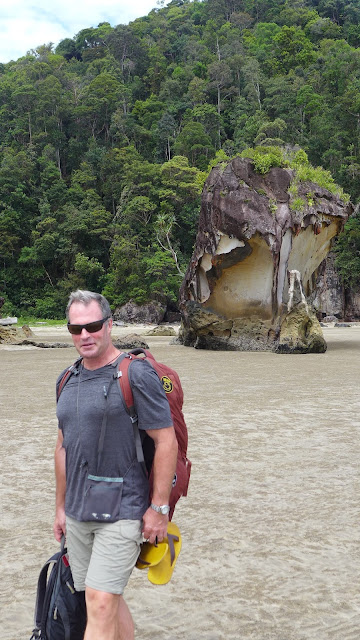 |
| The rocks at the beach, much like Remy's face, have been chiselled and worn by the weather. |
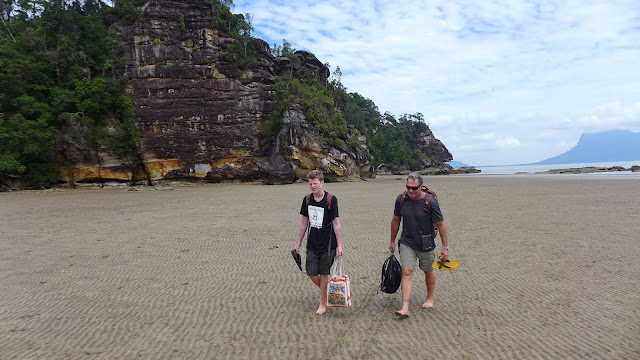 |
| This is what booking the luxury room at Bako Park gets you if you arrive at low tide. At high tide, you get to land at a dock that is equally far away from the park headquarters in the other direction. It does give you a sense that you are somewhere remote! |
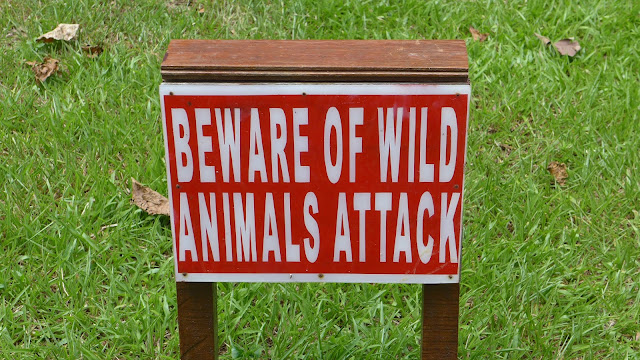 |
| There are too many different types of animals to list, so they leave the message generic. |
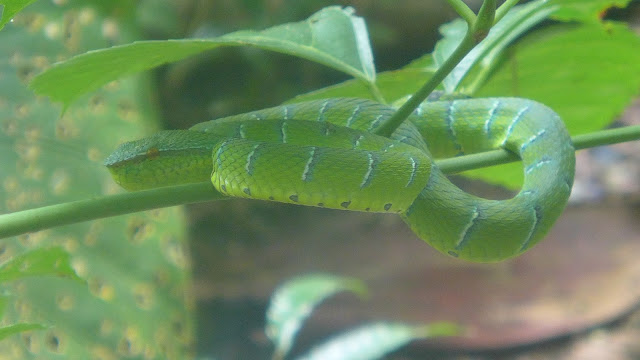 |
| One of the animals referred to above- the poisonous Green Pit Viper. Luckily they are mostly a threat to frogs and small rodents, and generally stay in the same place for up to a month at a time until they get hungry again. They are primarily nocturnal as well, and the jungle is no place for a primate of any description after dark. |
 |
| The park is remarkably photogenic. At high tide, these flats are completely under water. At low tide, they are covered in small crabs and some sort of lungfish that skips along the edges of the waterway. |
 |
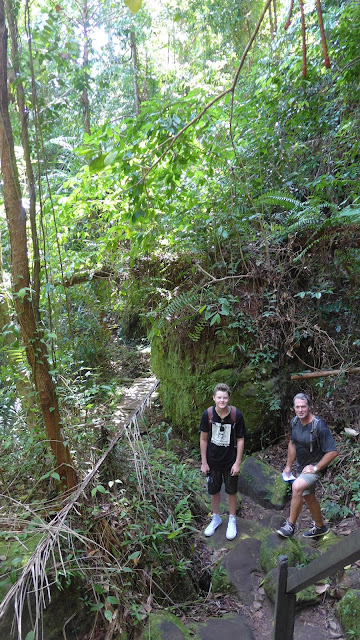
| "If we're in a park, goldarnit, we're going to hike." It was so hot in the jungle, we had to account for about one mile per hour progress, like hiking in the winter at home only with temperatures and humidity at the other extreme from what we are used to. |
 |
| A thousand shades of green in the jungle. And terrifically noisy, too, due to the cicadas and other bugs. |
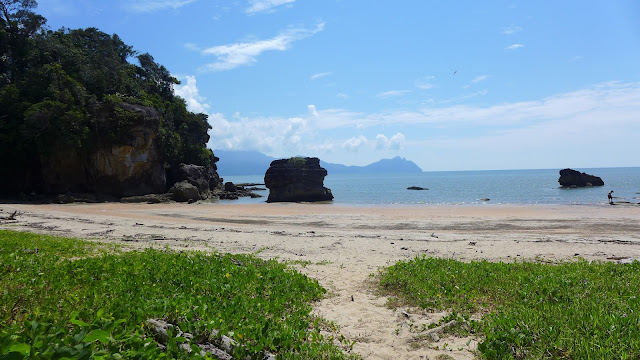 |
| Our reward! A beach at the end of the trail. |
 |
| The Borneo Bearded Pig - really! This was our first encounter with a large mammal, and luckily they are quite docile. They look like they'd make good eating too. |
 |
| Family portrait on the beach. |
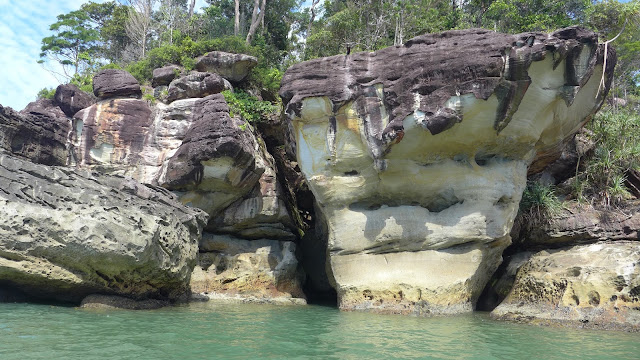 |
| We took advantage of the offer by an opportunistic water taxi captain who showed up at to travel by boat to the next beach up the coast and look at the rock formations along the way. The sandstone shores in the park are quite beautiful. |
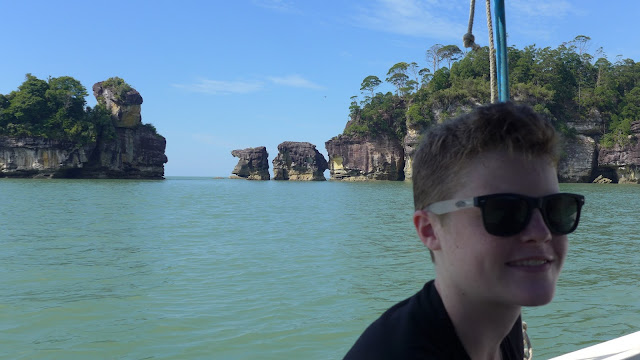 |
| It is way better to be in a boat with a cool breeze that to be slogging through the jungle! Bowen is happy with where we are at. |
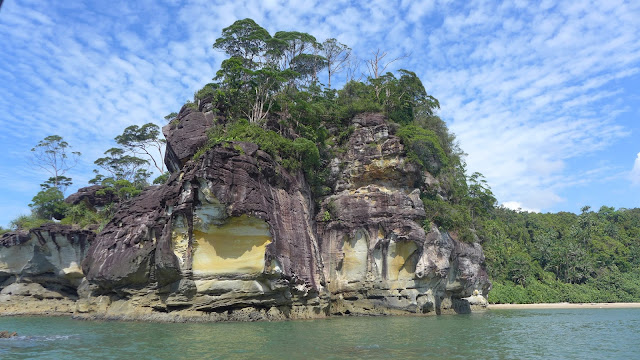 |
| You have to be in a boat to see these formations. |
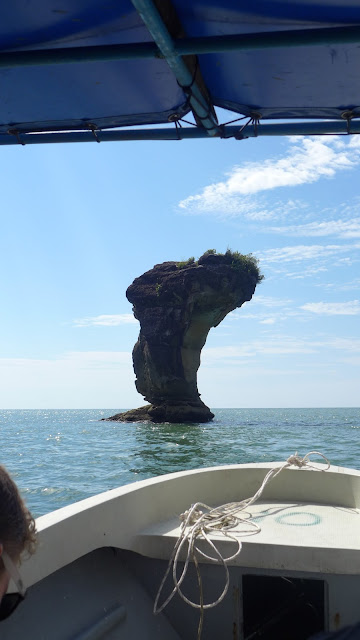 |
| One of the haystacks that people come out to see. We all tried to see the different shapes in the rock that the captain said were visible, but dehydration was robbing us of our imagination. |
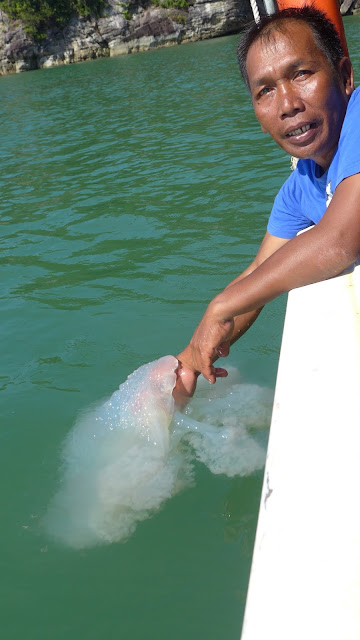 |
| Our captain explaining which parts of the giant jellyfish are good to eat and how to separate them from the parts that are not. |
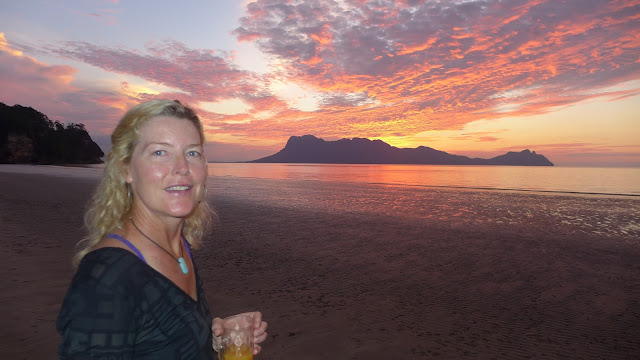 |
| Yes, the backdrop is real! We had some fantastic sunset at Bako Park. |
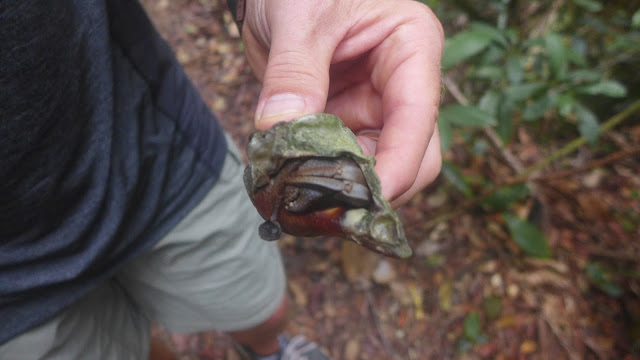 |
| The hermit crabs here are giant, and found way into the jungle. |
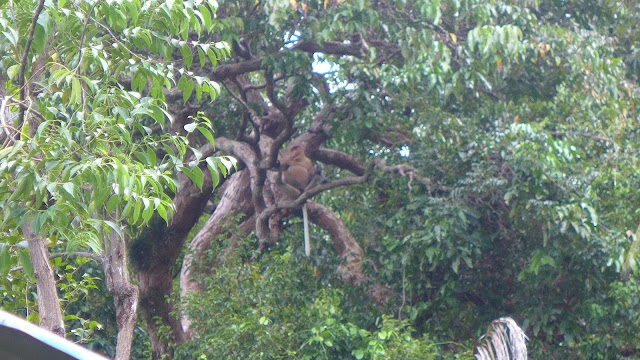 |
| We did early morning excursions each day to visit the proboscis monkeys in the mangrove swamp. You can see the grey tail of one hanging straight down. Their coloration makes it look like they are wearing waistcoats, which is accentuated by their pot bellies, which are caused by all the gut flora they require to digest the otherwise noxious leaves that they subsist on. There is nothing normal about a proboscis monkey, least of all their bulbous noses. |
 |
| Everything in the jungle is BIG! |
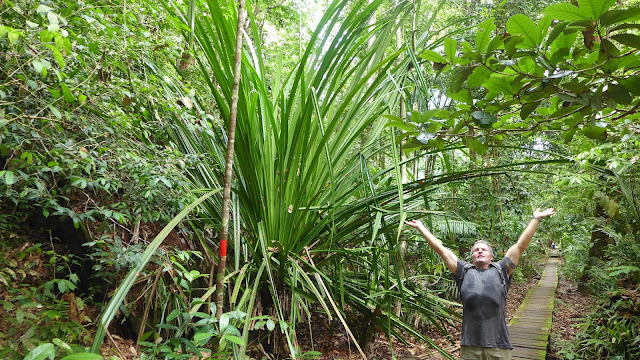 |
| Remy is connecting with his inner plant and trying to bloom in the jungle. |
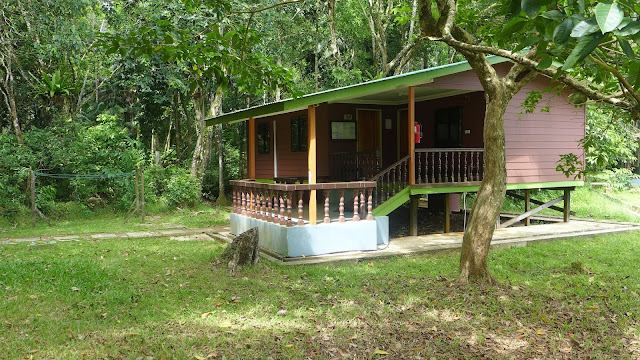 |
| Our deluxe cabin in the park. We had air conditioning and bars on the windows to keep the macaques out. |
 |
| Some of the beautiful beach scenery outside our park accommodations. It was nice to be able to be alone for a change, at least until the monkeys showed up. |
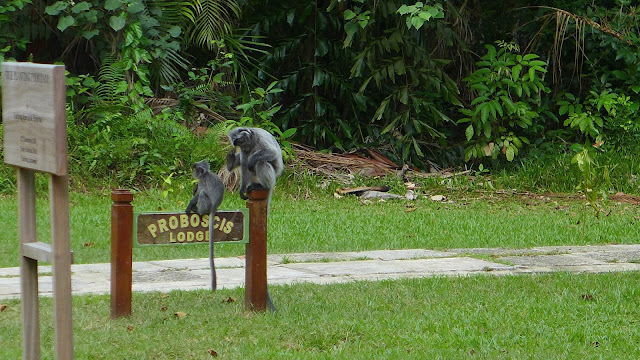 |
| Don't be fooled- those are Silver Leaf Monkeys, another species of primate found in the park. They are generally very shy. |
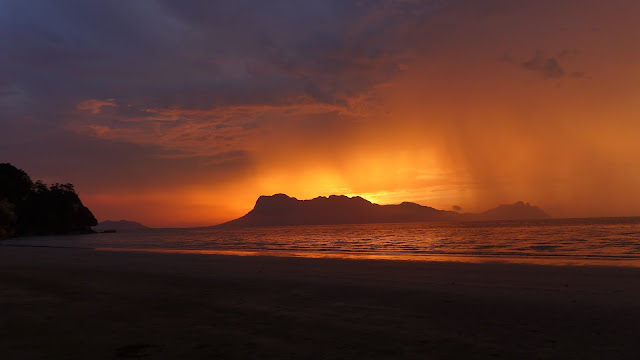 |
| We never take a beautiful sunset for granted. |
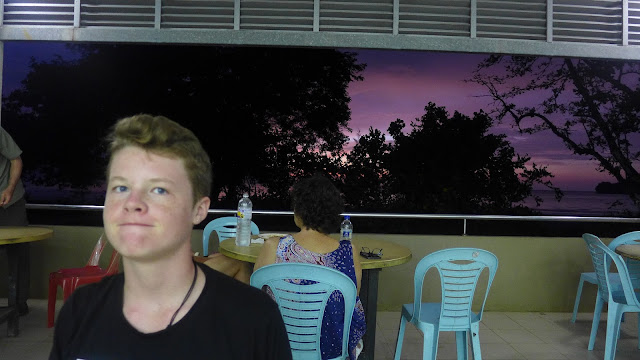 |
| The last purple light of sunset as seen from the dining room at the park headquarters. |
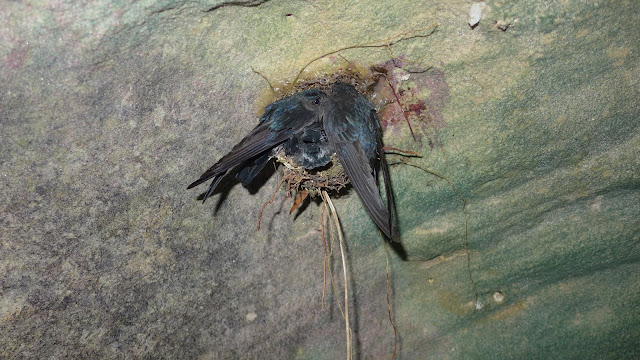 |
| This is a typical cave-dwelling swallow's nest, the type that get collected and turned into soup by the Chinese. At night both parents return to the nest (as seen here), while inside the tiny structure were three tiny chicks. It is hard to believe that they could all fit into so tiny a structure! The nest is composed of feathers and small twigs bound together with a sticky mucous produced by the adult birds. When processed for eating, they first have to be gathered at great peril from high up on the cliff walls, after which they are soaked and all the inedible bits are teased out, leaving only the swallow spit. Sounds yummy, huh? |
 |
| One of the creepy-crawlies we encountered on the night hike. There is nothing in the photo for scale, but this spider had a leg span the size of a plate and moved very quickly. We were able to spot the spiders in the dark by shining a flashlight into the jungle and seeing the diamond-like reflections of their eyes. It was amazing how many there were looking back at us! |
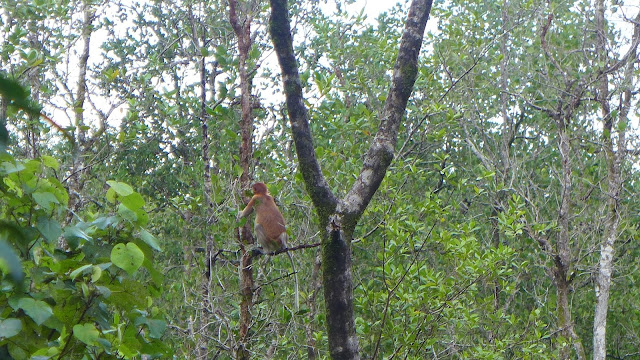 |
Another proboscis monkey to which we managed to sneak fairly close. They are quite shy and as soon they detected us the whole troop vacated the area in great spread-eagled leaps through the tree tops, snuffling and hooting as they went.
Our second night at the park was not as comfortable as the first, as we had to relocate to a fan-only room which had all the comforts of a jail cell. All in all, though, we greatly enjoyed our stay at the park as we got to see most of the big mammals as well as lots of birds, bugs and bats. It was daunting to be in the jungle after dark and to be aware of all the life that moves around when the sun goes down. We really felt that we had a good jungle experience! It helped that the food was a decent.
We returned to Kuching and the Threehouse Guest House to enjoy the comforts of the city and to plan our next leg of the journey.
|
 |
| This was such a simple yet elegant piece of design that we had to take a photo! A notch cut into the back of the chair for hanging a bag. This was located at our favourite bubble tea shop in the big mall in town. |
 |
| Bowen enjoying his drink at Gong Cha, the tea shop. The boy who refuses to eat bananas could not get enough of this cold creamy tea from which he would suck up the tapioca pearls or grass jelly that floated inside. |
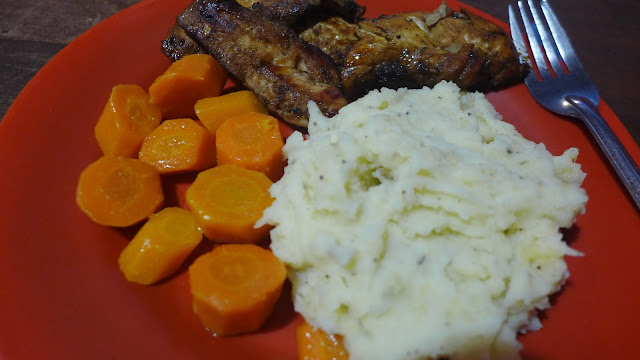 |
| It was so good the first time that Bowen cooked his signature dish again for the whole family- chicken tenders in root beer, mashed potatoes and carrots. It is nice to be able to cook for ourselves once in a while! |
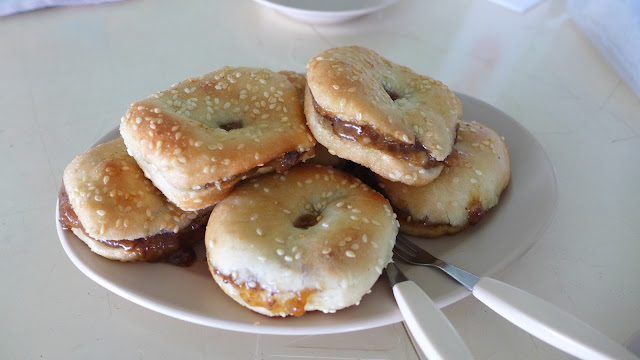 |
| This is a dish we have only found so far in Kuching- gong pia. The buns are chewy with a texture like a bagel, and the filling is a slightly sweet pork stew. They cost about $0.30 each, so it is easy to eat a whole plate full! |
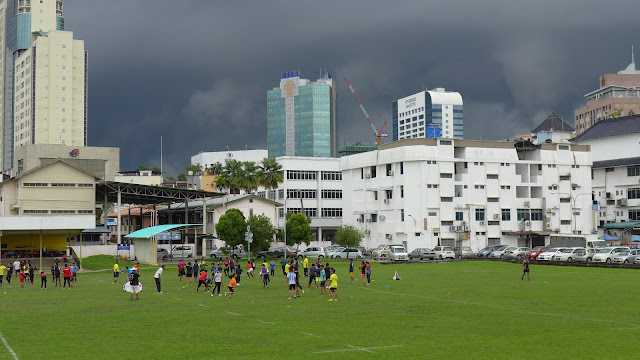 |
| The hawker centre where we found the gong pia happened to be located at the Kuching Rugby Club grounds, so we were able to watch the practise. A very thunderous storm rolled in while we were eating, and we got into a cab just in time to avoid the torrential downpour that followed. |
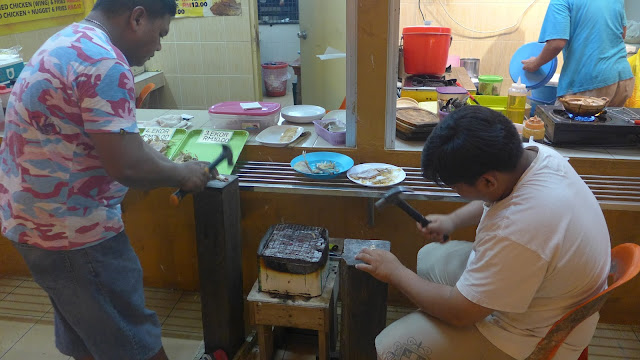 |
| This is how the dried squid is prepared- first it is hammered to soften it and give you a chance at actually masticating it, then it is put on the grill and warmed up. It is a big commitment to actually eat one! |
 |
| This shop owner actually let us test fire the blow guns in his shop. He told us that he has been able to hit pigeons across the street (when business is slow, I guess). Bowen invested in the backpacker version which is much shorter, but still comes with a dart quiver and half a dozen bamboo darts- not poisoned, of course. |
 |
| At the front doors of our guest house, which is actually owned and operated by a Swedish woman who fell in love with Borneo and decided to stay. |
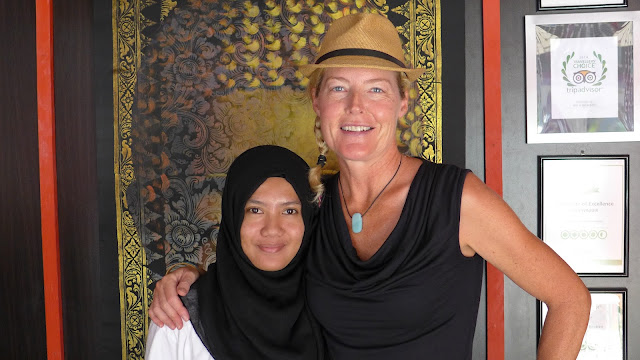 |
| Liz and Siti, one of the staff at the guest house. Liz was finally able to have a frank discussion with a Muslim woman about wearing the hijab and living as a woman in a Muslim society. |
 |
| A good place to plant yourself and have a cold drink. |
We really enjoyed our stay in Kuching, which was an excellent introduction to Borneo. We lapped up the colonial charm of the old town, and also had excellent experiences in the jungle. We liked the attitudes and the art of the locals, which is beautiful no matter what they do- tattoos, weaving, wood carving. It will be interesting to see how the other end of Borneo is the same and how it is different here. Next stop - Kota Kinabalu!
~Remy