Monday, August 10, 2015

Galungan in Bali. It's their biggest celebration of the year!

Bamboo poles ( panjor) ready to be decorated. It's amazing what the Balinese will do with these things over the next few days.
Holidays in Bali are like hockey games in Canada - you can bet there is one playing out somewhere, on some level, nearly every day. Part of the reason for this is the incredibly convoluted Balinese calendar system. To begin with, the entire year is only 210 days long, so annual holidays occur with a frequency of about seven months. Imagine a birthday every seven months! Then there is the fact that there are one- through 10-day weeks running concurrently, with extra days thrown into some of them. Each day is assigned a value, and there is some complex metric which must employ many brahmins full-time to figure out whether the consequent value of particular date, based on where it falls in these ten different weekly cycles, is auspicious or propitious enough for the celebration.

One of the bigger holidays, and one that we were lucky to be on the island for, is Galungan. It is actually the first day of a 10-day long holiday, with each day having its own name and ending on the final day known as Kalingan. The holiday marks the triumph of good over evil, and begins with much traffic to and from the temples by families of locals dressed in their traditional finery. It is believed that the spirits of ancestors and gods descend to Earth for the ten day period, and the rate at which offerings are proffered rises accordingly. 

The most obvious symbol of the holiday is the panjor, which is a long bamboo pole that is decorated elaborately and installed at the right hand side of the entrance to each family compound. The thinly tapered ends of the poles are bent to hang over the street, and from their ends hang offerings. At the base of the pole is an altar, which is stuffed with offerings for the gods and ancestors every day. The ridge of decorations that runs up the back of the panjor is meant to resemble a dragon's back.

The holiday is like a mix of Christmas and Halloween. There is much family time, and people generally return to their home village for at least the first few days of the holiday. Throughout the holiday, generally in the afternoons and evenings, gangs of young boys take the barong costume out of storage and accompany it through the streets with small bands of drums and gamelans. The barong enters peoples' homes and businesses, which is considered to be good luck, after which a member of the band hits up the occupants for a donation. It is an exotic form of trick or treat.

We were glad to be on the island, as it was in an extraordinarily beautiful state and the local population was extraordinarily happy.

Decorating the panjor seems to be the job of the men. All the decorations for this beauty were being made by hand from various grasses and palm leaves.

We are impressed with the detailed work that goes into creating a panjor.


This one is waiting to be erected as the ceremony date gets closer

This fella is putting the finishing touches on his. We like the use of natural and biodegradable decorations the best.

An incredible amount of work goes into these and considering they are left standing for just 30 days it's a pretty significant expense for a family. Some spend around $500 for theirs.

It's fun to drive around the villages on a motorbike and see what each family has created.  

The locals are especially happy to have us ask for a photo as they are very proud of their creations.

Watching the installation of a panjor is fun as they are very tall and it takes a few people to make sure the electrical lines don't get knocked down in the process.

A Sanggah cucuk or "throne" for the gods as they come down to earth.  There is one of these at the base of each panjor and gets filled with offerings for the gods.

So charming


This street had 100% participation which made for a great photo.

Neighbours, friends and family all help with the installation of each others panjor.

They are so delicate and lovely. We feel so lucky to be here at this time of year.


Everyone is dressed in their ceremonial best and are headed to their local temple. The man on the right is off to the cock fight at the temple.

The men always wear white when they go to the temple. We were a little shocked to see this guy drive away with his whole family on board and only one hand free for the handlebars of the bike.

Heading to the temple for the cock fight. Local women are not invited 

Here the men are gathered at the entrance and accepting a fee to attend the cock fight.

He was pretty shy about getting his photo taken. We love to see the little boys wearing the traditional outfits including the udeng

Can you tell we really like it here?


more panjors decorating the street.

Even the cars get decorated for the main event.

Monday, August 3, 2015

50 burning bodies. A mass cremation in Bali.


This is the vehicle that will transport the remains of a brahmin-class person to nirvana in a cloud of volatile inorganic compounds.
We were lucky enough while we were in Bali to be close by a village that had a mass cremation. This may not sound like lucky to us, but these are relatively infrequent events, and the Hindu belief in reincarnation means that death is not a particularly fearsome event - tiresome, more like it, as it means the departed is likely to have to take another turn on that wheel, with their performance in the most recently past life determining how the next one is to begin.

When a person dies in Bali, they are buried in the cremation grounds and marked with a headstone and possibly a small tree while their remains await cremation. Depending on the size and general wealth of the village, cremations are held only every few years (3 to 5 years is common, depending on the factors above). When the auspicious date for a cremation is determined by the responsible brahmin, based on the incredibly complex Balinese Hindu calendar, the preparations begin. For the deceased of the Brahmin caste, large figurines resembling bulls are built, while for the subordinate castes, lions or elaborate caskets are the appropriate vehicles for conveying their spirits to nirvana. The figurines are 7 or 8 feet in height, made of a wooden frame over which a papier mache skin is built, which in turn is covered in velour fake fur and decorated extensively with gold braid, rhinestones and other costume jewels. 

On the day in question, the remains of all the deceased are exhumed, in whatever state they may be, placed with great ceremony and many offerings in the figurines, and then torched. Often, to benefit from the economy of scale, the remains of related persons are placed in one figurine and burnt together. A man in the crowd pointed out the figurine in which his father and two brothers-in-law were to travel to heaven together. 

The remains are all paraded to the creation ground with great fanfare on small biers carried by men, each one with a few live chickens attached (chickens are believed to safeguard the remains, while they are buried, from malificent spirits in the woods) and accompanied by gamelan music and columns of women bearing bounteous offerings in beautifully woven baskets. The chickens survive the ceremony, by the way. The brahmin guides the families through the appropriate observations in preparing the remains for cremation en masse, using a PA system to give instruction. The cremations begin once everything is prepared, starting with the brahmin caste remains at one end of the grounds and proceeding across the grounds, and the castes, as the burners, equipped with huge gas torches, help the pyres get started and then ensure that the burning is fully completed. While a pyre burns, members of the family line up and brave the flames to toss small offerings.

The mood, while not particularly sombre, is not overly festive either. It is something that the whole family comes together to do in order to ensure that the deceased are properly sent off. Off course, when the whole family gathers, they need to be fed, so it is an occasion for bonding and fellowship, and the mass nature of the cremations brings the whole village together. Like every other holy celebration in Bali, there is a significant expense involved to ensure that it is done properly, so again it is a way of sharing those expenses. 

The final step in the process, once the fires have cooled, is to gather the ashes and take them to the sea. Considering the amount of land area on the island that is taken up by temples of various sorts, it is little wonder that they cannot devote any to permanent graveyards.


Most of the bulls were black.

Families waiting to add their offerings  before the fire starts. We like how brightly dressed everyone is! No dark depressing clothes for these people.

Everyone is taking pictures and our fellow tourists were as welcomed as we were, even the person on the right of the shot with the crazy footwear

Father and son wearing the traditional udong headdress.


It was a flurry of activity for many hours 

More remains being carried ceremoniously through the streets leading up to the cemetery.

Families having fun with Liz despite the nature of the gathering.

A most colorful procession


Bakso Ayam ( chicken ball soup) anyone? Hey, a guys gotta eat right, Chris?

Waiting on the side of the road and just watching the action

Spot the tourists?

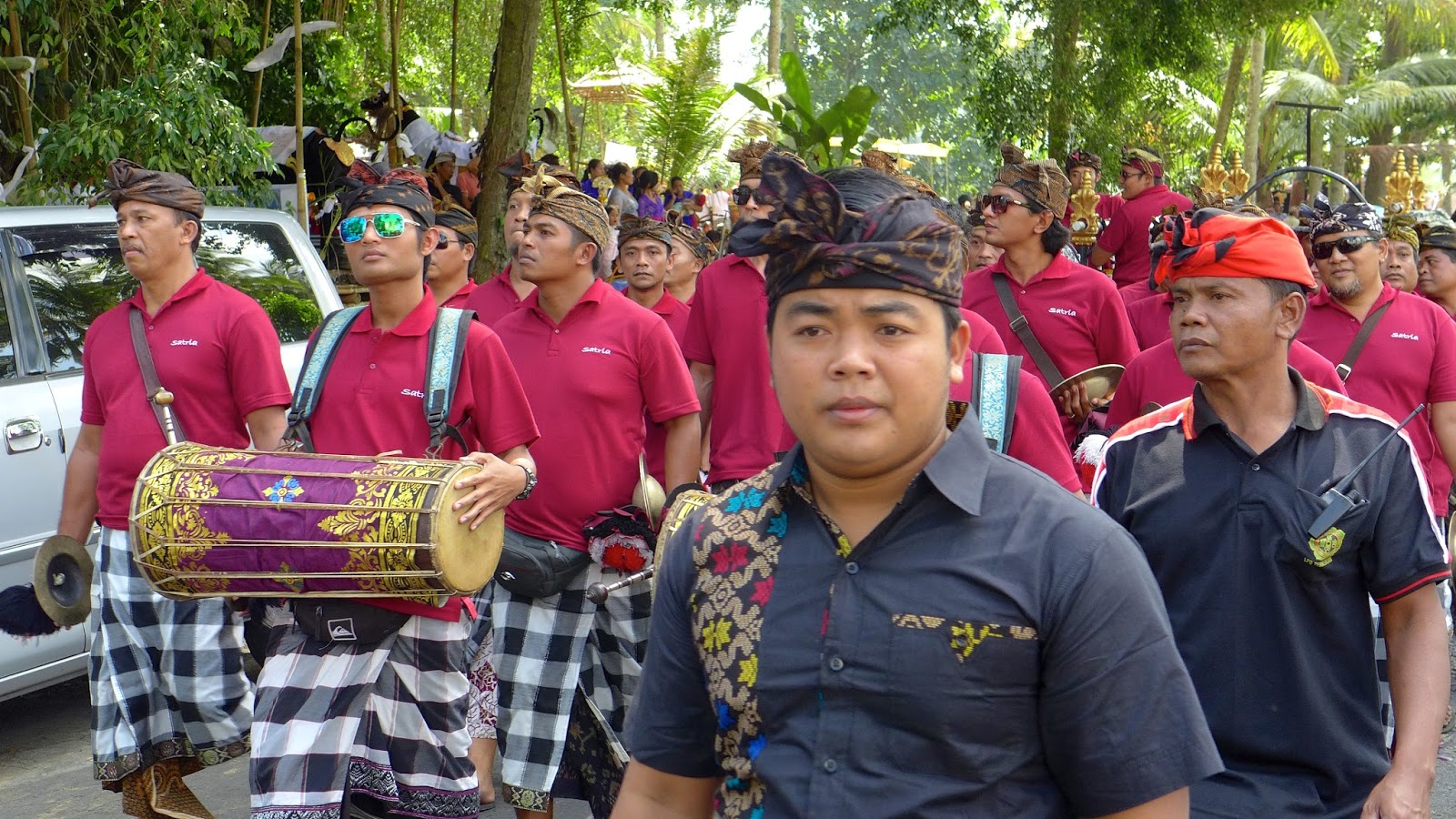
Drumming and music. This is a serious sendoff to the next life.

Our new  Canadian friends Chris, Nancy and their kids Aran and Eva.

Chicken feet soup.

We loved this knife set so much we couldn't resist getting one to bring home

They say you can't take it with you, but no one ever said that it could not be sent with you in Bali.

Our new friends are also travelling for a year with their two kids. These are our kinda people.

The fire is lit and stays lit with the aid of a propane torch.

We are shocked that all these fires didn't burn down the whole jungle.


It felt like being in a war zone. The potential for more death was very high but the unsafe nature of the whole event seemed to be lost on all attending except us.


We watched the locals posing in front of their own relatives burning up so we thought what the heck. While in Rome!

This was a top news story of the day

Everyone felt slightly weird and disrespectful posing for the camera but the locals didn't seem to notice even a little bit.

Traffic was backed up for miles so we were happy to have a motorbike so we could sneak away easily.


~ Liz and Remy

Rice, cat poop coffee and pig parts- more of Bali

With Dale as our intrepid guide, and Wayan as our intrepid driver, we all intrepidly embarked on a tour de l'isle. It was nice to get out of Seminyak and all of its beach culture frenzy. We had already done this for a day on motorbikes, and had learned our lesson, so this time we elected to travel in Wayan's van. Remy and Liz are overwhelmed by the natural and cultural beauty of this place, but Bowen was able to contain his own excitement and the rear seat of the van was suitable for him to sleep much of the journey.

We got an early start and headed north toward the central mountainous area of the island. The temperatures cooled as we climbed, and the crops changed as we got higher, switching from the ubiquitous rice crops of the lowlands to a large variety of other fruits and vegetables growing on the hillsides. Here, strawberries are considered a "cool weather" crop, and they grow year 'round.

But what captivates us the most is the architecture and people. Everything is adorned in a riot of symbolic decoration. The population of Bali is about 4 million, and there are 20,000 temples. Each temple has a "birthday" which is celebrated once every 210 days, according to the Balinese Hindu calendar, and then there are island-wide festivals thrown in on top of that. Plus, birthdays, cremations and weddings. There is a constant string of festivals being celebrated at the family, village and island levels, so it is a wonder that much gets done here.


This is the entrance portal to a small village. This one is slightly more grand than most, but not extraordinarily so. There is no doubt where city limits lie here.

This tree had blown down across the road, but there was no waiting for the "authorities" to come deal with it. Locals showed up with their chainsaws and had the road cleared in short order, and the wood was undoubtedly removed shortly after to begin its next phase of existence as a collection of carvings.

This group of women is making what is undoubtedly one of the thousands of trips to the temple to make yet another offering, which is carried in the baskets that they have.

Some rice terraces in the mountains, showing how the flow of water is regulated to maximize its potential in growing crops. 

Another view of the terraces. As was noted above, we never tire of these views. They are equally as pleasant a landscape as a golf course, but with far greater utility.

Remy, cleaving to a clove tree. Yes, those anaesthetic little spices grow right on the road side here, along with every other major spice you can think of and a few you've probably never heard of.

Remy, pounding his pestle as a means of learning how Bali coffee is produced. It is prepared much like "Turkish" or "cowboy" coffee, with finely ground beans being mixed directly into the water and drunk black and sweet. This was part of another tour of a spice garden, about which we have become quite blasé, naming the various herbs and spices before the guide can.

This is the creature responsible for luwak, or "cat poo" coffee. The civet gorges on fresh coffee berries, passing the beans whole but after having altered their character through the action of their digestive system. Imagine being the lucky fellow who gets to harvest those!

This was the view from where we had a break to test the wares of the coffee plantation and spice garden. 

Bowen, our traveling troubadour, playing "Stairway to Heaven" to our appreciative guide. We feel like we are partway up that stairway when we are in the mountains of Bali.

Part of Liz' "Portraits of Bali" series. 

One thing you can get on Hindu Bali that is not available in the rest of Muslim Indonesia is PORK! And here they eat every part of the pig but its squeal. Here is Remy's heaping portion of "babi guling", or roast pork, included meat, skin, liver and intestine, with a piece of sausage made out of everything else, with a delicious bowl of pork broth and gristle on the side. And all for about $3!

The shingle of the restaurant where we stopped for lunch. Lunch will appear as depicted. There is no excuse if a Muslim or vegetarian walks in here.

This looks important, but it is no big deal in Bali. This wall and gateway merely surround a family compound in a small village. And while it looks ancient, with the tropical climate here everything looks ancient in a very short time.

It is not all fun and games for us in Bali. Liz had to get some work done, and so had a few days of drudgery while we were at the Grand Kumala Inn. Here the poor thing slaves over her computer.
Those Balinese will decorate anything

Dale had some commitments back in North America, so we had to say goodbye in Seminyak. It had been a great visit with him, having him guide us around the island and introducing us to his friends. We felt privileged to have been able to share Bali with him, but now we had to go our separate ways.

We checked out of the Grand Kumala Inn and had Wayan drive us to Sanur, which has a much more laid-back vibe then Seminyak. That is the reason some refer to it as "Snore". We found ourselves a great hotel with three pools and settled in to decompress after the frenetic week before.

This doorway to a family compound was found down a narrow alleyway connecting the main road through Sanur to the beach. Admittedly, it is a nicer iteration, but is typical in its layout. It is going to be a difficult readjustment to the parsimonious architecture of home. How can you not appreciate the world, and your life, when this is how you see everything?

A slightly more reserved entranceway to a family compound.

Just as we never get tired of the rice paddies, Remy never gets tired of the frangipani fragrance. Here is another compound wall and entrance, but this one is constructed almost completely of coral. Gee, might that help explain what has happened to the island's reefs? Happily, the authorities have stopped this method of construction (where they actually enforce it).
Sanur was a nice break, as it allowed us to start getting into a more authentic Bali mood. We found the night market and tried some of the local food with the local people. We made it to the beach and tried to fly a kite. Remy had the same success at that particular endeavour as he does with fishing, so maybe there is some issue with sports that involve managing things at the end of a string. We made a self-guided motorcycle trip to the south end of the island, visiting a couple of surfing beaches and a temple where we saw a kecak performance (traditional a cappella dance performance - none of those annoying gamelans!) and fire dance, and successfully negotiated the manic Balinese traffic all on our own. But, Sanur lived up to its reputation, and began to bore us enough that we were willing to abandon our suite and swimming pools. We had heard enough about Ubud that we were ready to submit to its allure, so we engaged Wayan again to drive us to the interior.
~Remy